
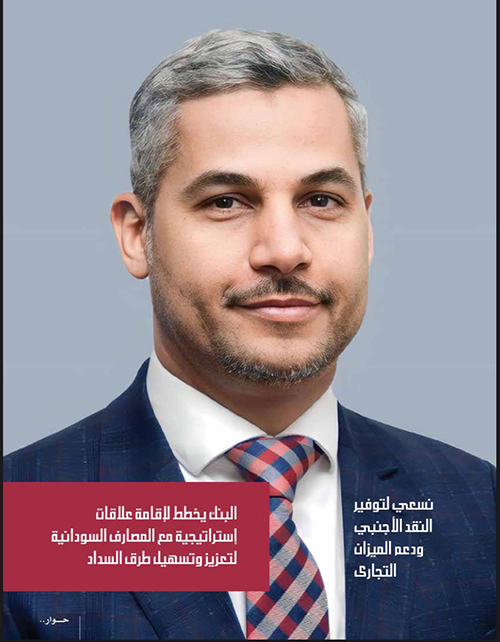
Blue Nile Mashreg Bank is one of the banks that has adopted a strategic approach, positioning itself on the shore of excellence. The CEO of Blue Nile Mashreg Bank, Mr. Akram Abdulazim Al-Baloulah, possesses distinguished expertise, graduating from international universities with a Bachelor's degree in Economics from the American University in Cairo and a Master's degree in International Relations from the University of Worcester, UK.
He has worked in important institutions, including the Bank of Khartoum, where he established the Bank of Khartoum in Abu Dhabi as a general manager. Before that, he worked at the Unicons consulting organization, which prepared the microfinance strategy for the Central Bank of Sudan.
In this interview with Hawas Magazine, he discusses the interests of Blue Nile Mashreg Bank, the challenges facing Sudanese banks, and proposes ideas to overcome them.
What is BNMB's approach to microfinance?
Blue Nile Mashreg Bank is keen on microfinance as one of the pivotal tools and fundamental solutions contributing to the development of Sudan's economy. The bank adopts a strategic partnership approach with specialized companies for their expertise in managing microfinance projects. In light of the current challenges facing the country, Blue Nile Bank will focus on financing microfinance companies operating in sectors that directly or indirectly contribute to enhancing the infrastructure for the development of exports, including crops, gold, or animal wealth.
What are the challenges facing banks in the post-war period?
There are internal and external challenges facing banks in the post-war period. Internally, the continuous devaluation of the Sudanese pound is one of the toughest challenges, leading to a real reduction in the capital value of banks and weakening their financing capacity. Externally, the biggest challenge will be maintaining relationships with correspondent banks, which may reduce their connections with Sudanese banks due to Sudan's classification as a high-risk country.
What are your plans in banking technology?
Blue Nile Mashreg Bank has introduced digital account opening services through the Mashreg application, making it the first bank in Sudan to link with the civil registry to verify provided data and then open an account in a process that takes no more than five minutes. The bank also collaborates with strategic partners to find suitable solutions for receiving remittances from Sudanese expatriates and delivering them securely and quickly.
How do you approach the problem of loan defaults?
One of the biggest contentious issues that must be dealt with quickly and wisely is the problem of defaulted loans. Three essential components must be available: first, the central bank providing aid packages to banks to help them refinance troubled companies; second, companies committing to repayment; and third, banks must be more flexible in calculating or even reducing their profit margins.
How do you view competition in the Sudanese banking sector?
Competition between banks is in the interest of the client and is necessary because it always places any bank outside the Comfort Zone, making it work hard to develop its products and services. We believe that competition should be in attracting the segment that does not deal with banks, providing services and products that contribute to enhancing financial inclusion. We consider all 36 banks in the Sudanese banking sector as important partners in developing the banking sector.
How do you balance experience between the pioneer and youth generations?
At Blue Nile Mashreg Bank, our culture emphasizes respect for both pioneers and youth in the work environment because each plays an important and central role in ensuring the continuity of the financial institution. The key in this equation is having management capable of prioritizing the institution's needs and effectively integrating the talents of both generations. We are confident that in the coming years, we will be able to restore Sudan's name as a pioneer in the development of the regional and global banking sector.